
David Joyner, President of US Bullion Reserve
The best gold bar size to buy for volume investors depends on a question most order forms never ask: how will you sell? A kilo bar keeps the unit count low, while a stack of 1 oz bars lets you sell a little at a time. Both hold the same metal, but they behave very differently on the day you need cash.
Bar size sets the smallest amount you can sell without selling more than you need. It also influences the cost per ounce, how storage is billed, and how much checking a buyer will want before paying. None of those factors points to one size that suits every buyer.
What follows compares the three sizes large buyers usually consider, shows where the cost differences come from, and gives a practical test for choosing sizes around the sales you are likely to make.
How Do 1 oz, 10 oz, and Kilo Bars Compare?
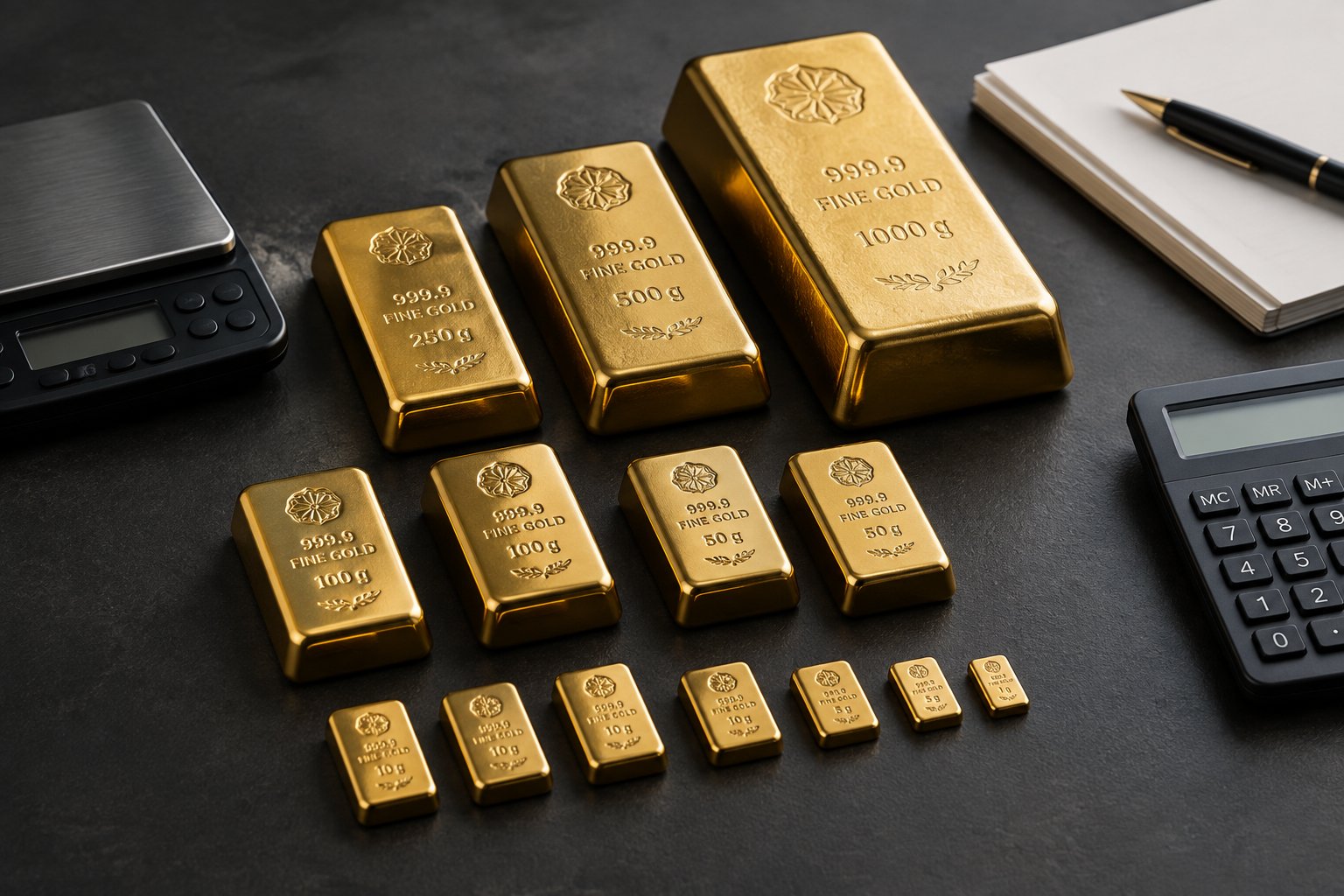
The three sizes trade unit count against sale flexibility. All are measured in troy ounces of about 31.1 grams, not the 28.35-gram ounce used for food, so compare invoices in fine troy ounces.
To make the arithmetic concrete, the examples below use an illustrative assumption of $4,000 per ounce. It is not a current quote or a forecast; recalculate every figure with the live price on the day you buy.
1 oz Bars: The Smallest Sale Unit
A 1 oz bar gives the most control over how much you sell. At the illustrative $4,000 price, a $250,000 allocation in 1 oz bars would be about 62 pieces, each with its own serial number and often its own assay card.
Storage takes little space, but inventory takes care. The benefit is reach: 1 oz bars suit the widest pool of buyers, and selling a few leaves the rest of the position untouched.
10 oz Bars: Fewer Pieces, Moderate Sale Size
A 10 oz bar at 999.9 fineness contains 9.999 fine troy ounces, according to the LBMA's bar weight conversion table. At the illustrative $4,000 price, each bar is worth about $40,000, so a $300,000 position is roughly seven or eight bars.
The trade-off sits between the other two sizes. Each sale is larger than a 1 oz bar but about one-third the size of a kilo.
Kilo Bars: The Most Compact Holding
A kilo bar contains about 32.15 troy ounces, worth roughly $128,600 at the illustrative $4,000 price. A $500,000 allocation fits in about four bars.
Kilos are familiar in the professional market, and refiners on the LBMA Good Delivery List produce them in both cast and minted form. The limit is the exit: each kilo is one sale unit, so a need for $15,000 still means selling a bar worth several times that amount.
What Determines the Cost per Ounce?
The price per ounce has three layers: the live spot price, the dealer's cost for the finished bar, and the premium added on top. Bar size mainly affects the middle layer, while order size can drive the top one.
Why Larger Bars Usually, but Not Always, Cost Less per Ounce
Casting or minting one kilo bar takes less work per ounce than producing 32 separate 1 oz bars, so larger bars generally start from a lower fabrication cost. That advantage does not always reach the buyer. Refiner brand, product availability, and market conditions all move the price, and a widely stocked 1 oz bar can occasionally be quoted more tightly than a scarce larger bar.
Treat "larger is cheaper" as a starting assumption to test, not a rule. Compare quotes per fine ounce for each size on the same day, with the premium stated separately from spot.
How Order-Level Pricing Changes the Bar Decision
Some dealers set the premium by product, which makes bar size part of the pricing decision. Others set it by the order total. US Bullion Reserve's published tiers are the second type, charging 5% over dealer cost up to a $250,000 total, 4% up to $500,000, and 3% on larger orders, with a $50,000 minimum.
In the company's transaction agreement, a $300,000 purchase totals $312,000 and a $600,000 purchase totals $618,000. Under that structure, a $500,000 order sits in the 4% tier and comes to $520,000; the 3% rate begins above $500,000. Because the tier follows the total, choosing some smaller bars for flexibility does not change the tier, though dealer cost can still differ by size. Buyers near a breakpoint can review tier breakpoints by allocation.
How Does Bar Size Change Your Exit Options?
Bar size decides the smallest amount you can sell at once. That limit matters more to a buyer who expects periodic withdrawals than to one planning a single sale.
Selling Part of a Position
Bars are sold whole. A buyer holding $400,000 entirely in kilos who needs $15,000 for a tax payment must sell a full bar, then decide what to do with the surplus cash; buying back in later means paying a premium again.
The same buyer with part of the position in 1 oz or 10 oz units could sell closer to the amount needed. The cost of that flexibility is more pieces to track and, in some cases, a slightly higher cost per ounce at purchase.
Verification and Packaging at Sale
Buyers pay more readily for bars that are easy to verify. An intact package, a serial number that matches the assay card, and a known refiner mark speed up the sale. A bar that has left its packaging may need testing first.
Larger bars can draw closer checks because more money rides on each one, and weight or assay confirmation adds time and sometimes a fee. Keep bars sealed and purchase records in one place from day one.
Which Product Details Affect Resale?
Refiner, purity, and format can affect resale as much as size. Two bars of equal weight can sell at different prices because one comes from a better-known source.
Minted vs. Cast Bars
Minted bars are cut from rolled gold and struck, with sharp edges, a polished face, and often a sealed assay card. Cast bars are poured into molds and cooled, which leaves a rougher finish. Minting takes more steps, so minted bars often cost somewhat more per ounce.
Neither format changes the gold content. Sealed minted packaging can simplify a later sale, while cast bars may suit buyers focused on ounces for the dollar.
Purity, Marks, and Refiner Standing
Investment bars are commonly .9999 fine. The LBMA's London Good Delivery standard requires large bars to carry a serial number, refiner's mark, fineness, and year of manufacture, and refiners on the Good Delivery List must pass ongoing testing. Many smaller bars from those refiners carry similar marks.
Check that the serial number on each bar matches its certificate at delivery. A recognized refiner mark is one of the simplest ways to reduce questions when you sell.
What IRA Buyers Should Confirm
Gold held in an IRA must meet the fineness standard for bullion and stay in the physical possession of a bank or approved non-bank trustee; home storage of IRA gold is not permitted. Bar size adds a practical question: how the depository bills storage.
Ask the custodian three things:
Does the bar and refiner meet the account's accepted-product list?
Does the depository accept that bar size?
Is storage billed by value, by ounce, or by the number of bars?
Per-bar billing can make many small bars more expensive to hold. This overview of IRA-eligible gold covers how storage is arranged.
The Best Gold Bar Size to Buy for Volume Investors: A Practical Test
There is no single right size for every volume buyer. The useful approach is to choose sizes around when and how you expect to sell.
Start With the Smallest Sale You Might Need
Estimate the smallest amount of cash you might need from gold in a single sale. Any bar worth more than that amount forces an oversized sale if that moment arrives. Using the same illustrative $4,000 assumption, a kilo is about $128,600, a 10 oz bar about $40,000, and a 1 oz bar about $4,000.
If you expect only large, planned sales, or intend to hold until a distant transfer, the smallest-sale limit matters less. If you expect periodic withdrawals, it matters more.
Weigh Unit Count, Storage Billing, and Premium
Three further inputs shape the answer:
Unit count: more pieces mean more records, more verification at sale, and potentially more per-bar fees.
Storage billing: value-based fees are neutral across sizes; per-bar fees favor larger bars.
Premium by size: compare dealer quotes per fine ounce on the same day rather than assuming a size advantage.
Running your own numbers through these inputs gives a size mix that fits your plans, whether that ends up as one size or several. Judging each quote against a fair premium benchmark keeps the per-ounce comparison honest.
Choose Bar Sizes Around the Sale You May Need
Finding the best gold bar size to buy for volume investors starts with the exit, not with the lowest quote on the day. When the premium is set by total order size, the bar mix can follow your sale plans without changing the tier.
US Bullion Reserve supplies gold bars in 1 oz, 10 oz, and kilo sizes at order-level wholesale pricing, with most orders shipping within 48 hours after funds are verified and the price is locked. To price a specific mix of sizes, call 1.855.655.4653 or ask a specialist for a quote, or review the available gold bar sizes first.
Frequently Asked Questions
How Many Troy Ounces Are in a Kilo Gold Bar?
A kilo gold bar contains about 32.15 troy ounces. A 10 oz bar at 999.9 fineness contains 9.999 fine troy ounces, so one kilo holds a little more than three 10 oz bars.
Do Larger Gold Bars Always Have Lower Premiums?
No. Larger bars usually cost less to fabricate per ounce, but refiner brand, availability, and market conditions can change the quoted price. Comparing quotes per fine ounce on the same day is the reliable test.
Can Part of a Kilo Gold Bar Be Sold?
No. A kilo bar is sold as one unit. An owner of several kilos can sell one and keep the rest, but selling a smaller amount requires holding part of the position in smaller bars.
Does Bar Size Change the Premium Tier Under Order-Level Pricing?
Not when the dealer sets the premium by total order size. The tier follows the order total, although dealer cost for individual bar sizes can still differ.
How Does IRA Storage Billing Affect Bar Size Choice?
If a depository bills storage by the number of bars, many small bars can cost more to hold than a few large ones. If storage is billed as a percentage of value, bar size has little effect on the fee.
This content is for educational purposes only and is not investment, tax, or legal advice. Consult a licensed financial advisor before making investment decisions.